The Benefits of Full Body Strength Training
Full Body Strength Training Exercises remain one of the most effective ways to improve overall fitness, build lean muscle, increase strength, and support long-term health. Unlike workout splits that focus on only one or two muscle groups per session, full body training targets multiple major muscle groups during each workout, allowing individuals to train efficiently while building balanced strength throughout the body.
Many people assume strength training is only for athletes or people trying to build significant muscle mass. In reality, strength training benefits nearly everyone. Research consistently shows that resistance training supports bone health, improves mobility, helps maintain muscle mass as we age, enhances daily function, and contributes to better overall quality of life. Strength training is recommended for adults of all ages and fitness levels because of its broad health benefits.
At Fight Gravity Fitness, many clients discover that full body workouts provide the ideal combination of efficiency and effectiveness. Busy professionals, parents, and individuals returning to exercise often find that full body routines fit their schedules while delivering measurable results. Whether your goal is improving strength, losing body fat, enhancing mobility, or simply feeling better throughout the day, a structured approach can make a significant difference.
If you are looking for personalized guidance, the coaching team at Fight Gravity Fitness can help develop a program tailored to your specific goals and experience level.
TL;DR
Full body strength training allows you to train multiple muscle groups during each workout, making it one of the most efficient ways to build strength, improve mobility, support healthy aging, and increase overall fitness. This training approach helps improve posture, reduce injury risk, increase bone density, support metabolism, and make everyday activities easier. When performed consistently, full body workouts provide both short-term performance benefits and long-term health advantages.

Meet our Denver
Personal Trainers
Key Takeaways
Full body workouts train all major muscle groups efficiently.
Strength training supports healthy aging and muscle preservation.
Improved mobility and posture contribute to better movement quality.
Resistance training helps support bone health and joint stability.
Full body programs are ideal for busy schedules.
Consistency is more important than workout complexity.
Progressive overload drives long-term strength gains.
Strength training supports both physical and mental wellbeing.

Why Full Body Training Works So Well
Many exercise programs become overly complicated. Split routines, advanced programming methods, and constantly changing exercises can make training difficult to sustain.
Full body training simplifies the process while still delivering excellent results.
Multiple Muscle Groups in Every Session
Instead of dedicating one day to chest, another day to legs, and another day to back, full body workouts train several major movement patterns during a single session.
A typical workout may include:
Pulling movements
Pressing movements
Core training
Hip hinge exercises
This approach creates a more balanced stimulus throughout the body.
Greater Training Frequency
One major advantage of full body programs is increased training frequency.
Because each session includes all major muscle groups, individuals can stimulate muscle growth and strength development multiple times each week without requiring daily workouts.
Research consistently shows that training muscle groups multiple times weekly can be highly effective for strength development and muscle maintenance.
Better Time Efficiency
Many adults struggle to find hours every day for exercise.
Full body training allows people to:
Train two to four times per week
Maintain consistency
Improve overall fitness
Avoid spending excessive time in the gym
This efficiency is one reason why Fight Gravity Fitness often incorporates full body principles into client programs.
How Full Body Strength Training Supports Everyday Life
One of the biggest misconceptions about strength training is that its benefits remain limited to the gym.
In reality, many of the most important benefits show up during everyday activities.
Carrying and Lifting Become Easier
Daily activities often require strength.
Examples include:
Carrying groceries
Moving furniture
Lifting children
Climbing stairs
Carrying luggage
Full body strength training improves the muscles used during these tasks.
According to New Mexico State University's strength training guide, resistance training helps reduce limitations during everyday activities and improves overall physical function.
Improved Posture Throughout the Day
Modern lifestyles often involve:
Sitting at desks
Working on computers
Driving long distances
Looking down at phones
Over time, these habits contribute to muscular imbalances.
Strength training helps strengthen:
Upper back muscles
Core muscles
Glutes
Postural stabilizers
These improvements support better posture and movement quality.
Reduced Physical Fatigue
People often assume exercise creates fatigue.
While workouts create temporary fatigue, long-term strength development frequently improves energy levels and physical resilience.
Daily tasks simply require less effort when the body becomes stronger.

“Strength training is one of the most valuable things you can do for your body. It improves how you move, how you feel, and how you perform in everyday life.”
The Relationship Between Strength Training and Healthy Aging
One of the most important benefits of full body strength training is its role in supporting healthy aging.
Maintaining Muscle Mass
Muscle loss naturally occurs as we age.
Without resistance training, adults gradually lose strength and muscle tissue over time.
Strength training helps slow or reduce this process. Maintaining muscle mass supports independence, mobility, and physical function later in life.
Supporting Bone Density
Bone health becomes increasingly important with age.
Strength training creates mechanical stress on bones that encourages bone maintenance and development.
This can help reduce the risk of osteoporosis and other bone-related concerns.
Maintaining Independence
Many adults focus on appearance when they begin exercising.
However, long-term fitness often becomes more about maintaining independence and quality of life.
Strength supports activities such as:
Getting up from chairs
Climbing stairs
Carrying household items
Maintaining balance
These abilities become increasingly valuable over time.

Full Body Strength Training Exercises Improve Metabolic Health
Strength training affects more than muscles.
It also supports important metabolic processes.
Supporting Healthy Body Composition
Resistance training helps maintain lean muscle tissue during weight loss efforts.
This can contribute to healthier body composition over time.
Blood Sugar Management
Research suggests strength training can improve blood sugar regulation and support insulin function.
For many individuals, resistance training becomes an important component of an overall health strategy.
Long-Term Weight Management
While nutrition remains the primary driver of weight loss, strength training helps support long-term maintenance by preserving muscle mass and encouraging an active lifestyle.
Major Movement Patterns Every Full Body Program Should Include
Successful programs typically focus on fundamental movement patterns rather than endless exercise variation.
Squat Pattern
Examples include:
Bodyweight squats
Goblet squats
Front squats
Split squats
These movements strengthen the lower body while improving overall stability.
Hip Hinge Pattern
Examples include:
Deadlifts
Romanian deadlifts
Hip bridges
Kettlebell swings
These exercises strengthen the posterior chain and improve power production.
Push Pattern
Examples include:
Pushups
Dumbbell presses
Overhead presses
These movements build upper-body strength and stability.
Pull Pattern
Examples include:
Rows
Pull-downs
Assisted pull-ups
Pulling exercises support posture and shoulder health.
Core Stability
Examples include:
Planks
Dead bugs
Core training supports spinal stability and movement efficiency.
Preventing Common Strength Training Mistakes
Even effective training programs can produce poor results if common mistakes are not addressed.
Doing Too Much Too Soon
One of the most common errors beginners make is trying to progress too quickly.
Examples include:
Adding weight too rapidly
Training too many days per week
Performing excessive workout volume
Ignoring recovery
Strength development is a long-term process. Consistent progression almost always produces better results than aggressive short-term efforts.
Ignoring Recovery
Muscles do not grow during workouts.
They grow and adapt during recovery.
Important recovery strategies include:
Adequate sleep
Proper nutrition
Hydration
Rest days
Stress management
Without sufficient recovery, performance often plateaus.
Using Poor Technique
Technique matters.
Poor movement patterns can reduce exercise effectiveness and increase injury risk.
The strength training recommendations from New Mexico State University emphasize proper form, controlled movement, full range of motion, and appropriate breathing techniques during exercise.
Working with qualified coaches can help ensure exercises are performed correctly from the start.
How Often Should You Perform Full Body Workouts?
One of the most common questions people ask is how often they should train.
The answer depends on experience level, goals, and recovery ability.
Beginners
Most beginners see excellent results with:
2 to 3 sessions per week
Full-body programming
Focus on movement quality
This frequency allows adequate recovery while building consistency.
Intermediate Lifters
Intermediate trainees often benefit from:
3 to 4 sessions per week
Progressive overload
Increased training volume
As fitness improves, training demands can gradually increase.
Recovery Matters More Than Frequency
More workouts are not always better.
The goal is finding a frequency that supports:
Recovery
Progress
Consistency
Lifestyle balance
Many clients at Fight Gravity Fitness achieve excellent results with three structured sessions per week.
Why Full Body Training Works for Busy Professionals
Modern schedules create unique challenges for fitness.
Many professionals struggle with:
Long work hours
Family responsibilities
Commutes
Travel schedules
Stress
Full body programs help solve these challenges.
Fewer Weekly Sessions Required
Unlike some advanced split routines, full body workouts allow individuals to train effectively without spending five or six days per week in the gym.
This improves long-term adherence.
Every Workout Matters
When every session trains the entire body, missed workouts become less disruptive.
Individuals continue progressing without feeling like they have fallen significantly behind.
Better Return on Time Invested
Many people simply want the best results for the time available.
Full body training delivers exceptional efficiency.
That balance makes it one of the most practical approaches available.
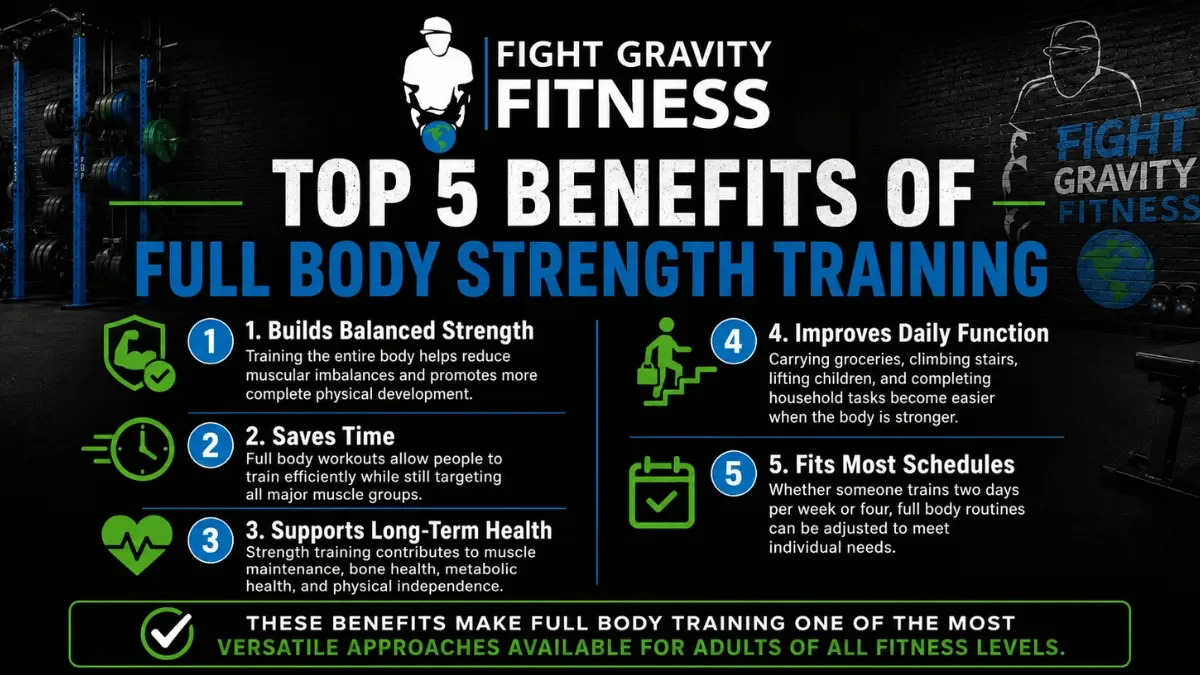
Top 5 Benefits of Full Body Strength Training
1. Builds Balanced Strength
Training the entire body helps reduce muscular imbalances and promotes more complete physical development.
2. Saves Time
Full body workouts allow people to train efficiently while still targeting all major muscle groups.
3. Supports Long-Term Health
Strength training contributes to muscle maintenance, bone health, metabolic health, and physical independence.
4. Improves Daily Function
Carrying groceries, climbing stairs, lifting children, and completing household tasks become easier when the body is stronger.
5. Fits Most Schedules
Whether someone trains two days per week or four, full body routines can be adjusted to meet individual needs.
These benefits make full body training one of the most versatile approaches available for adults of all fitness levels.
Strength Training and Mental Wellbeing
Physical improvements are often the most visible outcomes of strength training.
However, many people experience meaningful mental benefits as well.
Increased Confidence
Strength development creates measurable progress.
Seeing improvement over time often increases confidence both inside and outside the gym.
Reduced Stress
Exercise serves as a valuable outlet for managing daily stress.
The New Mexico State University guide notes that strength training may help reduce symptoms associated with anxiety, depression, and fatigue while improving self-esteem.
Improved Cognitive Function
Research also suggests that resistance training may contribute to improvements in memory and thinking skills.
For many people, these mental benefits become just as valuable as the physical results.
Building a Sustainable Full Body Training Routine
The most effective program is the one you can maintain consistently.
Start Simple
Many people overcomplicate fitness.
A simple program that includes:
Squats
Hinge movements
Push exercises
Pull exercises
Core training
Can produce excellent results.
Focus on Consistency
Consistency beats perfection.
Missing occasional workouts is not a problem.
Quitting entirely is.
Building habits that fit your lifestyle should remain the priority.
Track Progress
Monitoring progress helps maintain motivation.
Useful metrics include:
Strength improvements
Exercise performance
Body composition changes
Mobility improvements
Energy levels
Progress often occurs gradually, making tracking especially valuable.
Seek Professional Guidance When Needed
Working with experienced coaches can accelerate learning, improve technique, and help avoid common mistakes.
At Fight Gravity Fitness, coaching focuses on helping clients build sustainable habits and long-term success rather than chasing quick fixes.
FGF’s Client
Success Stories
FAQs
Are full body workouts effective for beginners?
Yes. Full body workouts are often ideal for beginners because they train all major muscle groups, reinforce movement patterns, and support balanced development.
How many days per week should I perform full body strength training?
Most adults benefit from two to four sessions per week depending on experience level, recovery ability, and goals.
Can full body training build muscle?
Absolutely. When paired with progressive overload and proper nutrition, full body training can support significant muscle development.
Is full body training better than split routines?
Neither approach is automatically better. Full body training is often more efficient and practical for many adults, especially those with busy schedules.
What equipment is required for full body workouts?
Full body workouts can be performed using bodyweight exercises, resistance bands, dumbbells, kettlebells, barbells, machines, or combinations of these methods.
Can older adults benefit from strength training?
Yes. Strength training supports muscle mass, bone health, mobility, independence, and overall quality of life for older adults.
Conclusion
Full Body Strength Training Exercises offer one of the most effective and practical ways to improve overall fitness, build strength, enhance mobility, and support long-term health. By training multiple muscle groups during each session, individuals can maximize efficiency while developing balanced strength throughout the body.
Whether your goal is improving daily function, maintaining muscle mass as you age, supporting metabolic health, or increasing overall confidence, full body training provides a proven framework for success. Research continues to demonstrate that strength training supports physical health, mental wellbeing, and quality of life across all age groups.
At Fight Gravity Fitness, we help clients implement structured, sustainable strength programs that fit real-world schedules and goals. Through personalized coaching, proper progression, and consistent support, clients build strength that extends far beyond the gym.
If you are ready to move better, feel stronger, and create a sustainable fitness routine, Fight Gravity Fitness can help guide your next steps.

Nicholas Butler
Founder, Fight Gravity Fitness
Nick Butler is a passionate fitness professional who believes that better movement leads to a better life. As the founder of Fight Gravity Fitness, he specializes in helping busy professionals build strength, restore mobility, and enjoy an active, pain-free lifestyle. Nick holds certifications as a NASM Certified Personal Trainer, TRX Certified Instructor, Silver Sneakers Certified, and is CPR Certified. With years of experience and a focus on functional movement, Nick brings a supportive, practical approach to fitness that gets results without the hype.