Carb Cycling vs. Traditional Dieting: Which Is Better for Fat Loss?
If you've spent any time researching how to lose fat, you've probably run into carb cycling — the strategy of eating more carbohydrates on some days and fewer on others. It's popular with physique competitors and gets promoted as a smarter, more strategic way to lean out than "just eating in a deficit." On the other side sits traditional dieting: a steady, consistent daily approach where your food intake stays roughly the same from one day to the next. So which one actually works better for fat loss?
The honest answer is that both can work, and neither is magic. Fat loss ultimately comes down to a handful of fundamentals that no eating pattern can override. But the way you structure your nutrition still matters, because the best plan isn't just the one that works on paper — it's the one you can follow consistently, week after week, without burning out. That's the lens we use at Fight Gravity Fitness, where sustainable habits always beat short-term extremes.
Many people assume carb cycling is inherently more advanced or effective, and that a "basic" steady diet is somehow leaving results on the table. In reality, the added complexity of carb cycling is a benefit for some people and a liability for others. Whether it's the right choice depends far more on your experience, your schedule, and your personality than on any special metabolic effect.
This guide breaks down exactly how carb cycling and traditional dieting work, what the science actually supports, where each one shines, and — most importantly — the fundamentals that drive fat loss no matter which approach you choose. By the end, you'll know which one fits your life, and what to focus on first.
TL;DR
Carb cycling means alternating higher-carb and lower-carb days — often aligning more carbs with harder training days — while traditional dieting keeps your intake steady from day to day. Both can produce fat loss because both work through the same underlying driver: a consistent calorie deficit paired with enough protein. Carb cycling adds structure and can help experienced, consistent people manage energy and performance, but it also adds complexity. For most people, a simpler traditional approach is easier to stick with and just as effective. Choose the one you'll actually follow.
Key Takeaways
Carb cycling alternates higher- and lower-carbohydrate days; traditional dieting keeps intake steady.
Both approaches drive fat loss through the same fundamentals: a calorie deficit and adequate protein.
Carb cycling offers structure and variety, which helps some people stay consistent.
The added complexity of carb cycling isn't necessary for most people, especially beginners.
No eating pattern overrides total calorie balance over time.
Strength training and protein protect muscle while you lose fat.
The best approach is the one you can maintain consistently, not the one that sounds most advanced.
What Is Carb Cycling?
Carb cycling is a nutrition approach where you deliberately vary your carbohydrate intake across the week rather than keeping it the same every day. Instead of eating the same amount of carbs daily, you plan higher-carb days and lower-carb days, and you rotate between them based on your training, your goals, or simply a set schedule.
The most common way people structure it is to align carbohydrate intake with training demand. On days with hard, demanding workouts, carbohydrates go up to fuel performance and support recovery. On rest days or lighter days, carbohydrates come down, with the idea that the body can rely more on stored fat for energy when carbs are lower. Protein typically stays relatively consistent across all days, since it's the nutrient most responsible for preserving muscle during fat loss.
How Carb Cycling Works
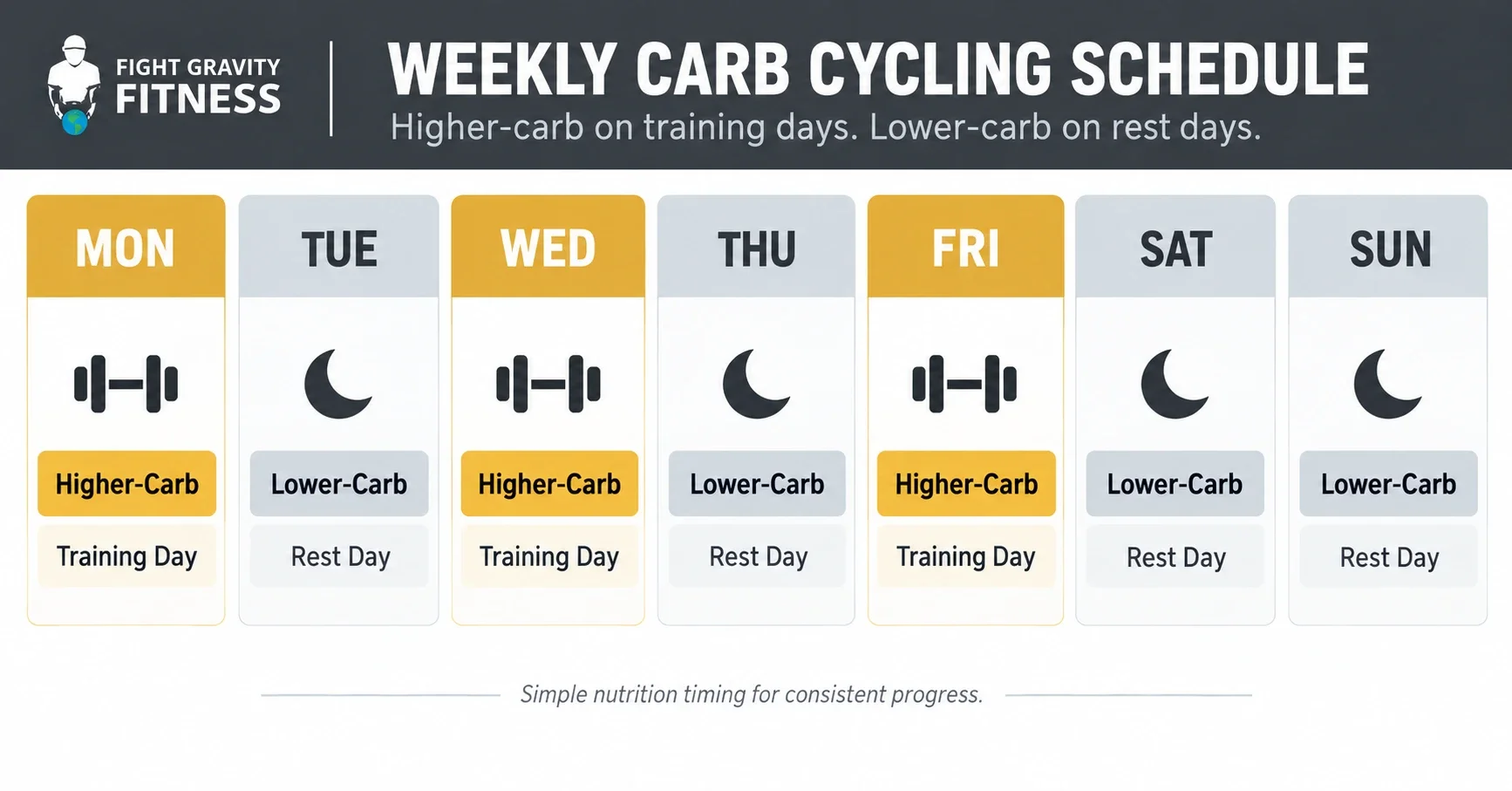
The theory behind carb cycling is that matching fuel to demand gives you the best of both worlds: enough energy to train hard when it counts, and lower-carb periods that may encourage the body to use fat for fuel. Some proponents also point to potential effects on hormones related to appetite and metabolism during dieting.
Here's the important nuance: the evidence for a unique metabolic advantage from carb cycling is limited. What carb cycling reliably does is provide structure and variety. Higher-carb training days can feel more satisfying and support better workouts, while lower-carb days help keep your weekly calorie total in check. For the right person, that rhythm makes a diet easier to follow. But it doesn't bypass the fundamentals — if your total weekly calories aren't in a deficit, cycling your carbs won't create fat loss on its own.
What Is Traditional Dieting?
Traditional dieting is the straightforward approach most people picture when they think about losing fat: you eat at a consistent calorie level each day, with relatively stable macronutrients, aiming for a modest deficit that leads to gradual, steady fat loss. Your carbohydrate intake stays roughly the same whether it's a training day or a rest day.
The appeal here is simplicity. There's only one "version" of your day to plan for, which makes grocery shopping, meal prep, and eating out far easier to manage. You're not tracking which type of day it is or adjusting portions accordingly — you build a handful of reliable meals and repeat them. For anyone juggling a busy schedule, that simplicity is a genuine advantage, not a compromise.
Why the Steady Approach Works
Traditional dieting works because it delivers the two things fat loss actually requires — a consistent calorie deficit and adequate protein — without any added moving parts. Research from organizations like the Academy of Nutrition and Dietetics consistently emphasizes sustainable, balanced eating patterns over rigid or complicated ones, precisely because consistency is what produces long-term results. A plan you can repeat on autopilot is a plan you're far more likely to still be following three months from now, and that adherence is the real driver of change.
Carb Cycling vs. Traditional Dieting: The Key Differences
When you place the two side by side, the differences come down to structure, flexibility, and how much day-to-day management each one demands.
Structure and Flexibility
Carb cycling is more structured. It gives you a built-in framework — higher carbs here, lower carbs there — that some people find motivating and easy to organize their week around, especially if they already train on a fixed schedule. Traditional dieting is more flexible in a different way: because every day looks the same, there's less to think about and fewer opportunities to get it "wrong." Which type of structure helps you depends heavily on your personality. Some people thrive on a plan with variety and rules; others do better with one simple pattern they never have to reconsider.
The Role of Total Calories
This is the part that gets lost in most carb-cycling hype: over a week, total calories and protein determine fat loss—not whether those calories were spread evenly or cycled. A well-run carb-cycling plan and a well-run traditional diet that land at the same weekly calorie and protein totals will produce very similar results. Carb cycling isn't a loophole around the fundamentals; it's just one way of organizing them. Once you understand that, the decision becomes much simpler: pick the structure you'll follow most consistently.

Top 5 Things That Actually Drive Fat Loss
Before you agonize over carb timing, make sure the real needle-movers are in place. These five fundamentals matter far more than whether you cycle your carbs.
1. A Sustainable Calorie Deficit
Fat loss requires taking in slightly less energy than you burn over time. The key word is sustainable—a modest deficit you can hold for months beats an aggressive one you abandon in two weeks. Both carb cycling and traditional dieting work only because they help you reach this deficit; neither replaces it.
2. Enough Protein
Protein is the most important macronutrient during fat loss. It helps preserve lean muscle while you're in a deficit, keeps you fuller between meals, and supports recovery from training. Keeping protein consistent day to day is smart no matter which dieting approach you choose.
3. Strength Training
Losing weight and losing fat aren't the same thing. Strength training signals your body to hold onto muscle while it sheds fat, which protects your metabolism and shapes the results you actually want to see. Pairing your nutrition with consistent resistance training — the foundation of private personal training in Denver at Fight Gravity Fitness — is one of the highest-return things you can do.
4. Consistency Over Perfection
The best diet is the one you follow most days, not the one you follow perfectly for a week and then quit. Small, repeatable choices compound. A "good enough" plan executed consistently will always outperform an ideal plan you can't maintain.
5. Sleep and Recovery
Poor sleep makes fat loss harder in every way— it increases appetite, saps training performance, and undermines recovery. Prioritizing rest isn't a bonus; it's a core part of any approach that works over the long haul.
Who Should Consider Carb Cycling?
Carb cycling tends to suit people who are already consistent with the fundamentals and want a bit more structure or performance support. If you train on a predictable schedule, enjoy planning your nutrition, and have several months of steady habits behind you, cycling your carbs around your hardest sessions can be a useful tool. More experienced exercisers and those chasing specific physique goals often appreciate the framework it provides.
For most people — especially beginners, or anyone with a hectic, unpredictable week — the added complexity isn't worth it. If tracking two different types of days feels like a burden, that friction makes you less likely to stay consistent, which works against the very goal you're pursuing. In that case, a simple traditional approach is almost always the better starting point. You can always add complexity later, once the basics are second nature.

FAQs
Is carb cycling better than a regular diet for fat loss?
Not inherently. Both work through the same fundamentals — a calorie deficit and adequate protein. Carb cycling adds structure that helps some people stay consistent, but it doesn't produce faster fat loss on its own when total calories are equal.
Do I need to cut carbs to lose fat?
No. Carbohydrates don't prevent fat loss; excess total calories do. You can lose fat while eating a reasonable amount of carbs, as long as your overall intake supports a deficit.
How does carb cycling work on training days?
The typical structure puts higher carbohydrate intake on harder training days to fuel performance and recovery, and lower carbohydrate intake on rest or lighter days, while keeping protein consistent throughout.
Is carb cycling safe for beginners?
It's generally safe, but it's often unnecessary and overly complicated for beginners. New exercisers usually see better results by mastering a simple, consistent approach first and adding complexity later if they want to.
What matters most for fat loss?
A sustainable calorie deficit, enough protein, strength training, consistency, and good sleep. These fundamentals drive results far more than carb timing or any specific dieting style.
Can I combine carb cycling with strength training?
Yes, and that's exactly where it fits best. Aligning higher-carb days with your most demanding strength sessions can support performance and recovery, as long as your overall weekly nutrition still aligns with your goal.
Conclusion
When it comes to carb cycling versus traditional dieting for fat loss, the most useful thing to understand is that neither approach has a monopoly on results. Both work by helping you reach a consistent calorie deficit with enough protein, and both fail if that foundation isn't there. The differences are about structure and fit, not some hidden metabolic edge.
If you're organized, consistent, and enjoy a bit of strategy, carb cycling can be a helpful framework — especially paired with hard training days. If you want simplicity and sustainability, a steady traditional diet is just as effective and far easier to live with. The right answer is the one you'll actually follow, week in and week out, long enough to see it through.
That's where having a plan built around your real life makes all the difference. At Fight Gravity Fitness, we help clients cut through the noise and focus on what actually works — sustainable nutrition, smart strength training, and the accountability to stay consistent. No fads, no guesswork, just steady progress you can maintain.

Nicholas Butler Founder, Fight Gravity Fitness
Nick Butler is a passionate fitness professional who believes that better movement leads to a better life. As the founder of Fight Gravity Fitness, he specializes in helping busy professionals build strength, restore mobility, and enjoy an active, pain-free lifestyle. Nick holds certifications as a NASM Certified Personal Trainer, TRX Certified Instructor, Silver Sneakers Certified, and is CPR Certified. With years of experience and a focus on functional movement, Nick brings a supportive, practical approach to fitness that gets results without the hype.